This is the 30th day in a 30 day challenge from Teach Thought.
Day 30: What would you do (as a teacher) if you weren’t afraid?
What would I do if I wasn't afraid? I would say "no" more often.
No. I won't add another test to my students' schedule just because you need "data" to prove that I am teaching. I consider it malpractice, actually.
No. I won't fill out more paperwork to prove that I am teaching. You are free to walk into my room and see my classroom in person.
No. I won't let you be disrespectful to me. I am a professional and deserve to be treated accordingly, especially since I am never disrespectful to you.
No. I won't do more with less. Please don't act like it is my duty as a teacher to continue to sacrifice my finances, health, and time without compensation.
No. I won't be chastised for someone else's carelessness. Please go speak directly to that individual.
No. I won't lie to my students that this mandated activity (survey, test, etc.) will have some importance to their future.
No. I won't pick up the slack for you. You earn the same pay that I do. Why should I work extra because you won't or can't do your job?
No. I am not crazy for wanting to teach high school students. It's what I love to do. Stop insulting my choice of career and be thankful that people like me exist.
No. Teaching isn't my "fallback" job. I didn't go into teaching because I couldn't hack it in some other important career.
Who knows? Maybe I will learn to say "no" more this year. It might be time to conquer my fear.
Showing posts with label 30 Day Challenge 2014. Show all posts
Showing posts with label 30 Day Challenge 2014. Show all posts
Tuesday, September 30, 2014

Monday, September 29, 2014
30 Day Reflection: 15 Years Later
This is the 29th day in a 30 day challenge from Teach Thought.
Day 29: How have you changed as an educator since you first started?
Oh, wow. I am not sure if this blog is big enough to document how much I have changed since I first started teaching, but I will certainly try.
Ways I have changed
1. I give my students more meaningful work now.
If you walked into my classroom you might have seen my students doing all sorts of fun, cutesy activities. My students had fun, but the activities weren't tied to my content or any standards. Many times those early lessons were about keeping students busy as I thought that is what a productive classroom looked like.
Now, my idea of productive is very different. My classroom sometimes looks chaotic. Students sit in groups or pairs and wrestle with difficult questions that can't easily be answered by searching on the internet or a fill-in-the blank worksheet.
2. I am not afraid to ask for help now
Early in my teaching career, I was so afraid of making a mistake and looking bad that I didn't ask for help when I clearly needed it. I chose to suffer in silence and spent a lot of time figuring things out on my own.
Some of that time was well-spent, but some of it was frustrating and a big waste of time. Now, I know that two or three heads are better than one. Many times, my colleagues are struggling with the same things. They often have tried and true techniques that could help me out. If only I had known this sooner...
Ways I have not changed
1. I still have trouble saying "no".
I am a people pleaser, and I hate to disappoint people. Match that quality with my insatiable need to learn about and grow in my teaching and you have me singing "I'm Just a Girl Who Can't Say No". While I am getting better at saying "yes" to everything, I still don't say "no" to everything I should. It's one of those things I will work on until I retire, I'm sure.
2. I still am a workaholic.
I am working on it. I really am. Thankfully, I have work friends who tell me to "go home" when six o'clock rolls around. They tell me not to feel guilty about taking an evening off or letting a stack of papers sit while I eat my lunch. Part of it is that I have a type A personality and am intrinsically motivated. When you pair those qualities with the responsibility I feel toward my students, it's no wonder I push myself the way I do.
Day 29: How have you changed as an educator since you first started?
Oh, wow. I am not sure if this blog is big enough to document how much I have changed since I first started teaching, but I will certainly try.
Ways I have changed
1. I give my students more meaningful work now.
If you walked into my classroom you might have seen my students doing all sorts of fun, cutesy activities. My students had fun, but the activities weren't tied to my content or any standards. Many times those early lessons were about keeping students busy as I thought that is what a productive classroom looked like.
Now, my idea of productive is very different. My classroom sometimes looks chaotic. Students sit in groups or pairs and wrestle with difficult questions that can't easily be answered by searching on the internet or a fill-in-the blank worksheet.
2. I am not afraid to ask for help now
Early in my teaching career, I was so afraid of making a mistake and looking bad that I didn't ask for help when I clearly needed it. I chose to suffer in silence and spent a lot of time figuring things out on my own.
Some of that time was well-spent, but some of it was frustrating and a big waste of time. Now, I know that two or three heads are better than one. Many times, my colleagues are struggling with the same things. They often have tried and true techniques that could help me out. If only I had known this sooner...
Ways I have not changed
1. I still have trouble saying "no".
I am a people pleaser, and I hate to disappoint people. Match that quality with my insatiable need to learn about and grow in my teaching and you have me singing "I'm Just a Girl Who Can't Say No". While I am getting better at saying "yes" to everything, I still don't say "no" to everything I should. It's one of those things I will work on until I retire, I'm sure.
2. I still am a workaholic.
I am working on it. I really am. Thankfully, I have work friends who tell me to "go home" when six o'clock rolls around. They tell me not to feel guilty about taking an evening off or letting a stack of papers sit while I eat my lunch. Part of it is that I have a type A personality and am intrinsically motivated. When you pair those qualities with the responsibility I feel toward my students, it's no wonder I push myself the way I do.
Sunday, September 28, 2014
30 Day Reflection: Chicken or Egg?
This is the 28th day in a 30 day challenge from Teach Thought.
Day 28: Respond: Should technology drive curriculum, or vice versa?
This almost sounds like the age-old question of which came first the chicken or the egg. The curriculum should drive technology, not the other way around. In fact, technology should be used to enhance the curriculum.
There should be a need and a purpose for technology being used in the classroom. The technology should complement the curriculum. Technology and the curriculum it supplements should adapt to the needs of our students.
Unfortunately, some schools jump in and purchase a tech tool or program thinking it will be the magic bullet to fix whatever ails them. Too often, in a few weeks' time reality sets in and teachers discover the tech doesn't fit the needs of some of their students. Or, worse yet, the infrastructure of the school doesn't support the tech. Then is sits in a closet or on a shelf collecting dust.
It's a mistake to assume, with curriculum or tech, that one size fits all. Our students' needs are diverse and to let anything except those needs drive the curriculum or Ed tech is careless.
Day 28: Respond: Should technology drive curriculum, or vice versa?
This almost sounds like the age-old question of which came first the chicken or the egg. The curriculum should drive technology, not the other way around. In fact, technology should be used to enhance the curriculum.
There should be a need and a purpose for technology being used in the classroom. The technology should complement the curriculum. Technology and the curriculum it supplements should adapt to the needs of our students.
Unfortunately, some schools jump in and purchase a tech tool or program thinking it will be the magic bullet to fix whatever ails them. Too often, in a few weeks' time reality sets in and teachers discover the tech doesn't fit the needs of some of their students. Or, worse yet, the infrastructure of the school doesn't support the tech. Then is sits in a closet or on a shelf collecting dust.
It's a mistake to assume, with curriculum or tech, that one size fits all. Our students' needs are diverse and to let anything except those needs drive the curriculum or Ed tech is careless.
Saturday, September 27, 2014
30 Day Reflection: No Manic Mondays
This is the 27th day in a 30 day challenge from Teach Thought.
Day 27:What role do weekends and holidays play in your teaching?
For some reason when I read this question the Bangles song "Manic Monday" started rolling through my head. That is the role weekends and holidays play in my teaching. They help me avoid manic Mondays.
I use weekends and holidays primarily for catching up on grading and planning. If I am lucky, I can get ahead for the week and my Monday morning isn't so stressful. Sometimes, I attend a conference. Often, I spend time updating my blog and class webpage. Other times, I have a chance to get to the paperwork that has piled on my desk for the week.
I also use the weekend to catch up on reading blogs, my Twitter feed, and Ed articles my teacher friends have recommended.
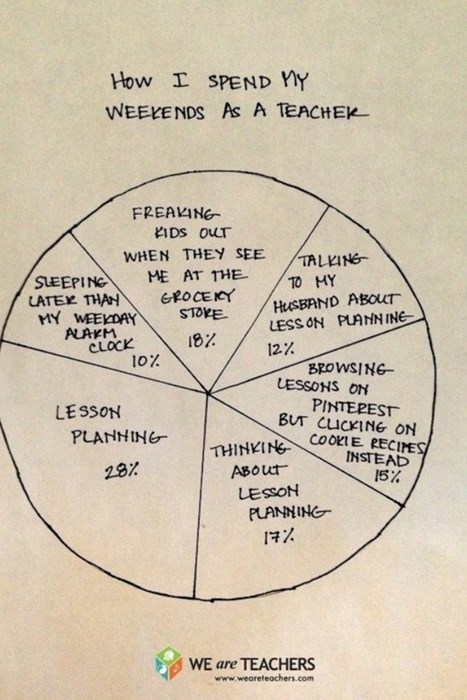
I am sure the way I spend my weekend isn't so different from other teachers, but I thought I would share my favorite graphic for what teachers do on weekends. It was originally posted by We Are Teachers.
Day 27:What role do weekends and holidays play in your teaching?
For some reason when I read this question the Bangles song "Manic Monday" started rolling through my head. That is the role weekends and holidays play in my teaching. They help me avoid manic Mondays.
I use weekends and holidays primarily for catching up on grading and planning. If I am lucky, I can get ahead for the week and my Monday morning isn't so stressful. Sometimes, I attend a conference. Often, I spend time updating my blog and class webpage. Other times, I have a chance to get to the paperwork that has piled on my desk for the week.
I also use the weekend to catch up on reading blogs, my Twitter feed, and Ed articles my teacher friends have recommended.
I am sure the way I spend my weekend isn't so different from other teachers, but I thought I would share my favorite graphic for what teachers do on weekends. It was originally posted by We Are Teachers.
Friday, September 26, 2014
30 Day Reflection: My Favorite (Professional) Things
This is the 26th day in a 30 day challenge from Teach Thought.
Day 26:What are your three favorite go-to sites for help/tips/resources in your teaching?
These are a few of my favorite things...
Twitter
I have praised Twitter before as a professional development source, but it really is my go-to site. I can pose a question to my PLN and get responses within minutes. Twitter has helped me reduce the hunt for resources. My teaching Tweeps offer thoughtful, honest reflection on their teaching. The resources they direct me to are teacher-tested. On most Thursday nights at 8 p.m. EST, you can find me on #KyEdChat learning from my wonderful Kentucky colleagues.
Blogs
I am still a relative newbie in the blogging world, and consider myself more of a lurker than a blogger, but blogs are one of my favorite sources of teaching ideas. There are too many blogs for me to list, but I tend to focus on blogs that deal with teaching literacy, literature, and writing.
English teacher gurus I stalk, uh, follow.
I discovered Jim Burke's work when I became a literacy coach in 2009. I have been reading his books, blogs, Twitter feed, and website ever since. He has wonderful, practical tips and tools for the teaching literacy.
I found Kelly Gallagher's work when I was teaching all senior English classes in 2006 and I was looking for strategies to help teach writing. I frequently pull out my copies of his books that I tabbed and re-read sections often. On his website, my two favorite resources are his Article of the Week and Kelly's Lists.
Day 26:What are your three favorite go-to sites for help/tips/resources in your teaching?
These are a few of my favorite things...
I have praised Twitter before as a professional development source, but it really is my go-to site. I can pose a question to my PLN and get responses within minutes. Twitter has helped me reduce the hunt for resources. My teaching Tweeps offer thoughtful, honest reflection on their teaching. The resources they direct me to are teacher-tested. On most Thursday nights at 8 p.m. EST, you can find me on #KyEdChat learning from my wonderful Kentucky colleagues.
Blogs
I am still a relative newbie in the blogging world, and consider myself more of a lurker than a blogger, but blogs are one of my favorite sources of teaching ideas. There are too many blogs for me to list, but I tend to focus on blogs that deal with teaching literacy, literature, and writing.
English teacher gurus I stalk, uh, follow.
I discovered Jim Burke's work when I became a literacy coach in 2009. I have been reading his books, blogs, Twitter feed, and website ever since. He has wonderful, practical tips and tools for the teaching literacy.
I found Kelly Gallagher's work when I was teaching all senior English classes in 2006 and I was looking for strategies to help teach writing. I frequently pull out my copies of his books that I tabbed and re-read sections often. On his website, my two favorite resources are his Article of the Week and Kelly's Lists.
Thursday, September 25, 2014
30 Day Reflection: Collaboration--It's a Process
This is the 25th day in a 30 day challenge from Teach Thought.
Day 25: The ideal collaboration between students–what would it look like?
Collaboration is a process, not an event. Therefore the process should be taught to students. Just because you put students (or adults, for that matter) in groups doesn't mean they know how to collaborate. Ideally, you should spend some time teaching students how to navigate disagreements, ask good questions, and listen to one another. They will need to take turns in each of the roles in a group: facilitator, task manager, timekeeper, recorder, and reporter.
Students need to learn that collaboration is social, but very different from socializing. Collaboration should be product-driven. It should allow students freedom to create and make mistakes. Students should be given time to explore both the learning process and the subject matter. The end result of the group's work should be shared with a larger audience. It should have a mix of face-to-face and online work.
Finally, students should be given time to reflect on the collaborative experience. This allows them to use the thinking routines you have taught them in class. Also, for the groups where everything didn't go as planned, the time to reflect is important so that those students don't write off collaboration as a bad experience. It will be helpful for those groups to see how another group was successful.
Day 25: The ideal collaboration between students–what would it look like?
Collaboration is a process, not an event. Therefore the process should be taught to students. Just because you put students (or adults, for that matter) in groups doesn't mean they know how to collaborate. Ideally, you should spend some time teaching students how to navigate disagreements, ask good questions, and listen to one another. They will need to take turns in each of the roles in a group: facilitator, task manager, timekeeper, recorder, and reporter.
Students need to learn that collaboration is social, but very different from socializing. Collaboration should be product-driven. It should allow students freedom to create and make mistakes. Students should be given time to explore both the learning process and the subject matter. The end result of the group's work should be shared with a larger audience. It should have a mix of face-to-face and online work.
Finally, students should be given time to reflect on the collaborative experience. This allows them to use the thinking routines you have taught them in class. Also, for the groups where everything didn't go as planned, the time to reflect is important so that those students don't write off collaboration as a bad experience. It will be helpful for those groups to see how another group was successful.
Wednesday, September 24, 2014
30 Day Reflection: PBL=A Mess I Love
This is the 24th day in a 30 day challenge from Teach Thought.
Day 24: Which learning trend captures your attention the most, and why? (Mobile learning, project-based learning, game-based learning, etc.)
The learning trend that "captures my fancy" the most is project-based learning (PBL). PBL provides a platform for teachers to work closely with students who are engaged in a high-quality, challenging task.
Students remember their PBL projects long after they complete them. More importantly, the learning transfers to other content areas and units. In other words, they retain the learning. Since most PBL is experiential, students are learning by doing and not simply to take a test or get a grade.
My experiences with Genius Hour have shown me that students who were apathetic in the regular classroom setting can approach a PBL task with wonder, determination, and professionalism. That excites me as a teacher. Actually, it sometimes makes me downright giddy. Ask my colleagues who have to hear me gush about my students' latest projects.
The work is messy. Strangely, that is my favorite part of PBL. I love that students have to think, problem solve, navigate group dynamics, and meet deadlines. Sounds a lot like life, doesn't it.
I know if my students can handle failure within the four walls of my classroom, they will be able to handle it in life. That lesson is more important than whether or not they remember every detail of the short story we are reading in class, don't you think?
Day 24: Which learning trend captures your attention the most, and why? (Mobile learning, project-based learning, game-based learning, etc.)
The learning trend that "captures my fancy" the most is project-based learning (PBL). PBL provides a platform for teachers to work closely with students who are engaged in a high-quality, challenging task.
Students remember their PBL projects long after they complete them. More importantly, the learning transfers to other content areas and units. In other words, they retain the learning. Since most PBL is experiential, students are learning by doing and not simply to take a test or get a grade.
My experiences with Genius Hour have shown me that students who were apathetic in the regular classroom setting can approach a PBL task with wonder, determination, and professionalism. That excites me as a teacher. Actually, it sometimes makes me downright giddy. Ask my colleagues who have to hear me gush about my students' latest projects.
The work is messy. Strangely, that is my favorite part of PBL. I love that students have to think, problem solve, navigate group dynamics, and meet deadlines. Sounds a lot like life, doesn't it.
I know if my students can handle failure within the four walls of my classroom, they will be able to handle it in life. That lesson is more important than whether or not they remember every detail of the short story we are reading in class, don't you think?
Tuesday, September 23, 2014
30 Day Reflection: Beyond the School's Walls
This is the 23rd day in a 30 day challenge from Teach Thought.
Day 23: Write about one way that you “meaningfully” involve the community in the learning in your classroom. If you don’t yet do so, discuss one way you could get started.
Four years ago, I decided to end the year with my sophomores by trying to incorporate all of the speaking and listening, writing, and reading skills into one project-based learning experience. This seemed like a perfect time to attempt this as the students had just completed their end of course exams in April and we still had five weeks left of school. I knew I needed to come up with something that was challenging and engaging for them. Also, I wanted them to have some freedom and choice during the project. Further, I didn't want this to be a project that students could simply "google". I wanted them to conduct research, interview people, and interact with artifacts.
This is when the Be True to Your School project was born. Our high school has an amazing, rich history and many of my sophomores didn't know much about the background of our school. The topic seemed perfect for the project. That first year of the project was a learning experience for all of us. The students determined what they needed and I scrambled to see if I could help them get it. The topics ranged from the school's first year in 1939, to the possible underground tunnels beneath the school, and many famous alumni.
First, the students decided that they needed access to more artifacts from our school's history. They wanted yearbooks, photos, and scrapbooks from the early years. I began asking teachers who had taught for awhile at Lafayette if they had any materials or knew where we could get items. Eventually, this led to the special collections library at the University of Kentucky. A teacher friend arranged for the special collections library to pull materials for my students to look through. I met several students at the library after school one day. It was amazing to see my students racing across the library clutching an old yearbook and whispering "Mrs. McPherson, you gotta see my grandpa's hair. It's hilarious!" For many of my students, this was their first experience combing through artifacts like scrapbooks, yearbooks, and old newspapers.
Next, the students asked if they could talk to alumni. So, I started recruiting former students to come speak to the students. I was able to have 15 different alumni come and speak on three different panels that first year. My favorite panel had a 1942 grad, and a 1973 grad. One of my students asked the panel what was an important cause the graduates were involved with during school. The 1942 grad talked about how there were no boys around because most of them had signed up to fight in World War II. The 1973 grad talked about receiving his draft card for the Vietnam War and how everyone in his class was worried about what would happen to them once graduation came. My students were amazed at the difference in the generations. It was one of those goose bumps moments that teachers sometimes have. I realized my students were getting a glimpse into history that they wouldn't have gotten through a lecture, website, or textbook.
I understand to an outsider that this unit isn't very English-y, but it is a unit my students will remember forever. It's a great way for my students to connect with the community beyond the walls of the school.
Day 23: Write about one way that you “meaningfully” involve the community in the learning in your classroom. If you don’t yet do so, discuss one way you could get started.
Four years ago, I decided to end the year with my sophomores by trying to incorporate all of the speaking and listening, writing, and reading skills into one project-based learning experience. This seemed like a perfect time to attempt this as the students had just completed their end of course exams in April and we still had five weeks left of school. I knew I needed to come up with something that was challenging and engaging for them. Also, I wanted them to have some freedom and choice during the project. Further, I didn't want this to be a project that students could simply "google". I wanted them to conduct research, interview people, and interact with artifacts.
This is when the Be True to Your School project was born. Our high school has an amazing, rich history and many of my sophomores didn't know much about the background of our school. The topic seemed perfect for the project. That first year of the project was a learning experience for all of us. The students determined what they needed and I scrambled to see if I could help them get it. The topics ranged from the school's first year in 1939, to the possible underground tunnels beneath the school, and many famous alumni.
First, the students decided that they needed access to more artifacts from our school's history. They wanted yearbooks, photos, and scrapbooks from the early years. I began asking teachers who had taught for awhile at Lafayette if they had any materials or knew where we could get items. Eventually, this led to the special collections library at the University of Kentucky. A teacher friend arranged for the special collections library to pull materials for my students to look through. I met several students at the library after school one day. It was amazing to see my students racing across the library clutching an old yearbook and whispering "Mrs. McPherson, you gotta see my grandpa's hair. It's hilarious!" For many of my students, this was their first experience combing through artifacts like scrapbooks, yearbooks, and old newspapers.
Next, the students asked if they could talk to alumni. So, I started recruiting former students to come speak to the students. I was able to have 15 different alumni come and speak on three different panels that first year. My favorite panel had a 1942 grad, and a 1973 grad. One of my students asked the panel what was an important cause the graduates were involved with during school. The 1942 grad talked about how there were no boys around because most of them had signed up to fight in World War II. The 1973 grad talked about receiving his draft card for the Vietnam War and how everyone in his class was worried about what would happen to them once graduation came. My students were amazed at the difference in the generations. It was one of those goose bumps moments that teachers sometimes have. I realized my students were getting a glimpse into history that they wouldn't have gotten through a lecture, website, or textbook.
I understand to an outsider that this unit isn't very English-y, but it is a unit my students will remember forever. It's a great way for my students to connect with the community beyond the walls of the school.
Monday, September 22, 2014
30 Day Reflection: What's in Your PLN?
This is the 22nd day in a 30 day challenge from Teach Thought.
Day 22: What does your PLN look like, and what does it do for your teaching?
Until a few years ago, my PLN looked like me. Most of the colleagues I associated with were high school English teachers. It was rare that I had the opportunity to work with someone who wasn't a teacher in my department. Thanks to a few amazing opportunities and Twitter, my PLN is diverse and large now.
In my PLN, there are teachers from all content areas and experience levels. This is where Twitter has been amazing to connect with teachers from all over the world. It isn't uncommon for me to take a picture of a bug and post it on Twitter for my science buddies to identify for me.
These teachers are the first ones I turn to when I have a content question or need a new strategy. My PLN keeps me up-to-date on new strategies and pedagogy. They challenge me and make me defend my teaching choices. None of them accepts the "because that's how we've always done it" response.
Also, I have teacher friends who help me with my policy questions. Thanks to them, I know what is going on in the Ed policy world. Often, they will send me an article or ask my opinion about a topic. It is because of their encouragement that I have ventured into the world of policy myself this year as a Hope Street Group Kentucky Teacher Fellow.
I really love that my PLN is diverse because sometimes I get stuck in my own little world inside Room 218. Sometimes I don't realize that other teachers have it better or worse than I do. Sometimes I can't see the forest for the trees. That is what my PLN does for me. They keep me engaged, motivated, and grounded.
Day 22: What does your PLN look like, and what does it do for your teaching?
Until a few years ago, my PLN looked like me. Most of the colleagues I associated with were high school English teachers. It was rare that I had the opportunity to work with someone who wasn't a teacher in my department. Thanks to a few amazing opportunities and Twitter, my PLN is diverse and large now.
In my PLN, there are teachers from all content areas and experience levels. This is where Twitter has been amazing to connect with teachers from all over the world. It isn't uncommon for me to take a picture of a bug and post it on Twitter for my science buddies to identify for me.
These teachers are the first ones I turn to when I have a content question or need a new strategy. My PLN keeps me up-to-date on new strategies and pedagogy. They challenge me and make me defend my teaching choices. None of them accepts the "because that's how we've always done it" response.
Also, I have teacher friends who help me with my policy questions. Thanks to them, I know what is going on in the Ed policy world. Often, they will send me an article or ask my opinion about a topic. It is because of their encouragement that I have ventured into the world of policy myself this year as a Hope Street Group Kentucky Teacher Fellow.
I really love that my PLN is diverse because sometimes I get stuck in my own little world inside Room 218. Sometimes I don't realize that other teachers have it better or worse than I do. Sometimes I can't see the forest for the trees. That is what my PLN does for me. They keep me engaged, motivated, and grounded.
Sunday, September 21, 2014
30 Day Reflection: Nerdy Teacher Fun
This is the 21st day in a 30 day challenge from Teach Thought.
Day 21: Do you have other hobbies/interests that you bring into your classroom teaching? Explain.
My three hobbies are reading, quilting, and gardening. I don't often have an opportunity to bring up quilting or gardening in the classroom, but I do incorporate my hobby of reading everyday.
Since I teach high school students, I spend some of my reading time on young adult literature. My main reason for reading YA lit is to have recommendations for my students who don't like to read. I want to promote a love of reading to my students and knowing what is hot in young adult lit is one way I can do that.
Also, YA lit is a great way to forge relationships with students. Throughout the year, students wander into my room and borrow books from my shelves. We talk about what books they are reading and give one another book recommendations. These conversations continue long after students leave my classroom. Students come back to visit from college and let me know what books they are reading. Many of them laugh about the books they used to read and tell me about the more mature books they have discovered in college.
My reading hobby is easy to bring into the classroom. It's one of the easiest ways I can connect with my students, and sometimes, match a book to a new reader. That's the best nerdy teacher fun I can have.
Day 21: Do you have other hobbies/interests that you bring into your classroom teaching? Explain.
My three hobbies are reading, quilting, and gardening. I don't often have an opportunity to bring up quilting or gardening in the classroom, but I do incorporate my hobby of reading everyday.
Since I teach high school students, I spend some of my reading time on young adult literature. My main reason for reading YA lit is to have recommendations for my students who don't like to read. I want to promote a love of reading to my students and knowing what is hot in young adult lit is one way I can do that.
Also, YA lit is a great way to forge relationships with students. Throughout the year, students wander into my room and borrow books from my shelves. We talk about what books they are reading and give one another book recommendations. These conversations continue long after students leave my classroom. Students come back to visit from college and let me know what books they are reading. Many of them laugh about the books they used to read and tell me about the more mature books they have discovered in college.
My reading hobby is easy to bring into the classroom. It's one of the easiest ways I can connect with my students, and sometimes, match a book to a new reader. That's the best nerdy teacher fun I can have.
Saturday, September 20, 2014
30 Day Reflection: To Display or Not to Display
This is the 20th day in a 30 day challenge from Teach Thought.
Day 20: How do you curate student work--or help them do it themselves?
As a high school teacher, curating student work has been a struggle, quite honestly. Unlike my elementary teacher friends, I did not get the bulletin board making gene. Seriously, how do you guys do that?
Over the years, I have tried putting work up on my little bulletin board in my classroom, but I struggle with how to make sure each student is represented. It's hard to rotate through 170 or more students in a year. And, if you think high school students don't notice or care when their work isn't displayed, you are wrong.
When I became a regular Twitter user, I started taking photos of student work and displaying it on my account. That can get a little sticky, though. I have to make sure not to capture my student's face or their name since some of their parents have signed technology display forms and some have not. The only way I can find out that information is to jump through a lot of hoops. And, I just don't have the patience for it. Remember, I am a high school teacher. We tend to get prickly about bureaucracy.
At the beginning of the year, I started a class Weebly page and I have been posting pictures of student work there. Again, I have to be careful about faces and names. And, I have to remember to post the pictures, too.
This year, corkboard strips are going to be placed in the space between the ceiling and the lockers outside of my room. I requested this at the end of last year, so I am hopeful that by Thanksgiving I will be able to display student work more easily. Plus, it's just a corkboard strip, so there isn't the pressure to create a cutesy bulletin board.
I would love to hear what other high school teachers do to curate student work.
Day 20: How do you curate student work--or help them do it themselves?
As a high school teacher, curating student work has been a struggle, quite honestly. Unlike my elementary teacher friends, I did not get the bulletin board making gene. Seriously, how do you guys do that?
Over the years, I have tried putting work up on my little bulletin board in my classroom, but I struggle with how to make sure each student is represented. It's hard to rotate through 170 or more students in a year. And, if you think high school students don't notice or care when their work isn't displayed, you are wrong.
When I became a regular Twitter user, I started taking photos of student work and displaying it on my account. That can get a little sticky, though. I have to make sure not to capture my student's face or their name since some of their parents have signed technology display forms and some have not. The only way I can find out that information is to jump through a lot of hoops. And, I just don't have the patience for it. Remember, I am a high school teacher. We tend to get prickly about bureaucracy.
At the beginning of the year, I started a class Weebly page and I have been posting pictures of student work there. Again, I have to be careful about faces and names. And, I have to remember to post the pictures, too.
This year, corkboard strips are going to be placed in the space between the ceiling and the lockers outside of my room. I requested this at the end of last year, so I am hopeful that by Thanksgiving I will be able to display student work more easily. Plus, it's just a corkboard strip, so there isn't the pressure to create a cutesy bulletin board.
I would love to hear what other high school teachers do to curate student work.
Friday, September 19, 2014
30 Day Reflection: 3 2 1 Reflect
This is the 19th day in a 30 day challenge from Teach Thought.
Day 19: Name three powerful ways students can reflect on their learning, then discuss closely which one you use most often.
Whole Group Debrief
One of my favorite ways to have students reflect on their learning is by asking two simple questions.
1. What did we do well today?
2. What do we need to work on?
These two questions typically illicit some very thoughtful and, often, brutally honest comments. It's a great way to assess whether or not a new activity or procedure went well or not.
Silent Conversation
I love to have my students help each other reflect, but I find that they often lose focus when talking face-to-face and their conversations get off track quickly. This is where the silent conversation strategy comes in handy. Sometimes, I will have students use post-it notes and write comments on another student's or group's work. I ask them to use three sentence starters.
1. I think...
2. I wonder...
3. Have you considered...
Again, students provide helpful feedback and the student whose work is being viewed can keep the post-it notes and address them on their time frame. Often, a student is too overwhelmed with the verbal conversation to remember everything that was said.
3-2-1 Minute Reflection
Sometimes when a student is completely stuck or overwhelmed by a task or text, I ask them to give me a 3-2-1 Minute Reflection. I tell them to set a 60 second timer on their phone and then jot down responses to the following prompts.
List 3 words associated with this task/text.
List 2 frustrations with this task/text.
List 1 question you want someone to answer about the task/text.
The reflection isn't overwhelming since it is only one minute long, Also, by having students write it down it gives them a response other than "I don't know" when we sit down to conference.
Day 19: Name three powerful ways students can reflect on their learning, then discuss closely which one you use most often.
Whole Group Debrief
One of my favorite ways to have students reflect on their learning is by asking two simple questions.
1. What did we do well today?
2. What do we need to work on?
These two questions typically illicit some very thoughtful and, often, brutally honest comments. It's a great way to assess whether or not a new activity or procedure went well or not.
Silent Conversation
I love to have my students help each other reflect, but I find that they often lose focus when talking face-to-face and their conversations get off track quickly. This is where the silent conversation strategy comes in handy. Sometimes, I will have students use post-it notes and write comments on another student's or group's work. I ask them to use three sentence starters.
1. I think...
2. I wonder...
3. Have you considered...
Again, students provide helpful feedback and the student whose work is being viewed can keep the post-it notes and address them on their time frame. Often, a student is too overwhelmed with the verbal conversation to remember everything that was said.
3-2-1 Minute Reflection
Sometimes when a student is completely stuck or overwhelmed by a task or text, I ask them to give me a 3-2-1 Minute Reflection. I tell them to set a 60 second timer on their phone and then jot down responses to the following prompts.
List 3 words associated with this task/text.
List 2 frustrations with this task/text.
List 1 question you want someone to answer about the task/text.
The reflection isn't overwhelming since it is only one minute long, Also, by having students write it down it gives them a response other than "I don't know" when we sit down to conference.
Thursday, September 18, 2014
30 Day Reflection: The Big Pink Eraser
This is the 18th day in a 30 day challenge from Teach Thought.
Day 18: Create a metaphor/simile/analogy that describes your teaching philosophy.
I love erasers. They are one of my favorite office supplies. Yep. I know that makes me strange, but I don't mind that designation. After all, I teach high school students and enjoy it. That alone, makes me different from the general population of adults in the world.
Years ago, I adopted the big pink eraser as a word picture for my teaching philosophy. I try really hard to communicate to my students that we will all make mistakes. Most of them can be fixed with a simple eraser. Others will require a little more hard work. I stress that some of my best learning has happened when I made a mistake and had to figure out how to fix it.
I try to model being gracious when someone points out one of my mistakes. Teens love to point out an adult's mistake, so the opportunity for me to model comes up often.
I tell students who make a big mistake and have to face the consequences that I will be waiting for them when they return to class. We can start over regardless of what happened the day before.
I remind them that they are not defined by their worst day. I encourage my students to pick up the eraser and write a new page.
I guess the big pink eraser philosophy seems simplistic, but if my students can learn to take risks, own up to their mistakes, and graciously accept correction, then I consider their time with me to be a success.
Day 18: Create a metaphor/simile/analogy that describes your teaching philosophy.
I love erasers. They are one of my favorite office supplies. Yep. I know that makes me strange, but I don't mind that designation. After all, I teach high school students and enjoy it. That alone, makes me different from the general population of adults in the world.
Years ago, I adopted the big pink eraser as a word picture for my teaching philosophy. I try really hard to communicate to my students that we will all make mistakes. Most of them can be fixed with a simple eraser. Others will require a little more hard work. I stress that some of my best learning has happened when I made a mistake and had to figure out how to fix it.
I try to model being gracious when someone points out one of my mistakes. Teens love to point out an adult's mistake, so the opportunity for me to model comes up often.
I tell students who make a big mistake and have to face the consequences that I will be waiting for them when they return to class. We can start over regardless of what happened the day before.
I remind them that they are not defined by their worst day. I encourage my students to pick up the eraser and write a new page.
I guess the big pink eraser philosophy seems simplistic, but if my students can learn to take risks, own up to their mistakes, and graciously accept correction, then I consider their time with me to be a success.
Wednesday, September 17, 2014
30 Day Reflection: Rethinking Teacher Time
This is the 17th day in a 30 day challenge from Teach Thought.
Day 17: What do you think is the most challenging issue in education today?
The biggest challenge in education today is re-thinking the use of a teacher's time during the work day. In the fifteen years that I have been teaching, the workload has steadily increased, yet my workday hours have remained the same.
I typically spend 4.5 hours directly in front of students. There are 55 minutes of my day where I am required to supervise students through a prescribed activity (tardy duty, early/late duty, etc.). That leaves 80 minutes to plan lessons, grade work, check e-mail, conference with colleagues, or parents. Naturally, to keep up with all of the work, I have to work an additional 2-3 hours a day. Many times, those extra hours are just not enough to keep up. Sometimes, I have to take an entire Saturday or Sunday to plow through the work.
It's time we rethink a teacher's schedule. Teachers should spend half the day instructing students and the other half of the day should be used to support that instruction. The non-instructional time would allow teachers time to plan, research, grade, meet with parents or students, collaborate with other teaches, and observe other teachers, and attend trainings to improve instruction.
Of course, if we start to rethink a teacher's time that means we should also rethink a student's time. That would require us to blow up our obsession with the clock, but I will save that discussion for another post.
In the meantime, have you read Peter Greene's blog post Teacher Time?
Day 17: What do you think is the most challenging issue in education today?
The biggest challenge in education today is re-thinking the use of a teacher's time during the work day. In the fifteen years that I have been teaching, the workload has steadily increased, yet my workday hours have remained the same.
I typically spend 4.5 hours directly in front of students. There are 55 minutes of my day where I am required to supervise students through a prescribed activity (tardy duty, early/late duty, etc.). That leaves 80 minutes to plan lessons, grade work, check e-mail, conference with colleagues, or parents. Naturally, to keep up with all of the work, I have to work an additional 2-3 hours a day. Many times, those extra hours are just not enough to keep up. Sometimes, I have to take an entire Saturday or Sunday to plow through the work.
It's time we rethink a teacher's schedule. Teachers should spend half the day instructing students and the other half of the day should be used to support that instruction. The non-instructional time would allow teachers time to plan, research, grade, meet with parents or students, collaborate with other teaches, and observe other teachers, and attend trainings to improve instruction.
Of course, if we start to rethink a teacher's time that means we should also rethink a student's time. That would require us to blow up our obsession with the clock, but I will save that discussion for another post.
In the meantime, have you read Peter Greene's blog post Teacher Time?
Tuesday, September 16, 2014
30 Day Reflection: Superpower
This is the 16th day in a 30 day challenge from Teach Thought
Day 16: If you could have one superpower to use in the classroom, what would it be and how will it help?
There is a t-shirt sold at teacher conferences that says "I teach. What's your superpower?" I always laugh when I see it. Sometimes I feel that teaching is my superpower. I like the suggestion that I am uniquely qualified to teach and that the act of teaching is powerful. In that sense, I guess teaching is my superpower.
Yet, there are many times when I feel that I am not enough. It's at those times when I wish I had a true superpower. I wish I had the power to clone myself. This power would come in handy several times throughout the day.
I could send my clones to help students who are waving their arms frantically while waiting for me to get around to all 30+ students.
If I could clone myself, then I wouldn't have to choose between grading those 170+ essays or responding to parent e-mails. I could send one clone to attend to each task.
If I had clones, I could send them to attend the after school meetings or trainings while I stay in my room and plan my lessons. Then maybe I could have a meal with my family on a regular basis.
If I had clones, I could send one in the hall to talk to the upset student while the other me stays in the room and keeps the other students focused. Or I could send them to be the test proctor while I meet with parents to discuss their student's progress.
It's nice to dream. Since I don't have this superpower, I need to get back to grading essays because I used my planning time to respond to e-mails today.
Day 16: If you could have one superpower to use in the classroom, what would it be and how will it help?
There is a t-shirt sold at teacher conferences that says "I teach. What's your superpower?" I always laugh when I see it. Sometimes I feel that teaching is my superpower. I like the suggestion that I am uniquely qualified to teach and that the act of teaching is powerful. In that sense, I guess teaching is my superpower.
Yet, there are many times when I feel that I am not enough. It's at those times when I wish I had a true superpower. I wish I had the power to clone myself. This power would come in handy several times throughout the day.
I could send my clones to help students who are waving their arms frantically while waiting for me to get around to all 30+ students.
If I could clone myself, then I wouldn't have to choose between grading those 170+ essays or responding to parent e-mails. I could send one clone to attend to each task.
If I had clones, I could send them to attend the after school meetings or trainings while I stay in my room and plan my lessons. Then maybe I could have a meal with my family on a regular basis.
If I had clones, I could send one in the hall to talk to the upset student while the other me stays in the room and keeps the other students focused. Or I could send them to be the test proctor while I meet with parents to discuss their student's progress.
It's nice to dream. Since I don't have this superpower, I need to get back to grading essays because I used my planning time to respond to e-mails today.
Monday, September 15, 2014
30 Day Reflection: Three Strengths
This is the 15th day in a 30 day challenge from Teach Thought
Day 15: Name three strengths you have as an educator.
Flexibility--Being flexible helps me keep my sanity. At any given moment, my carefully, crafted lesson plan can dissolve before my eyes.. Sometimes, I have to adjust within the five minutes I have between classes. Sometimes, I have to adjust mid-sentence when I realize the lesson is all wrong. If a teacher can't be flexible, then he or she will be miserable and, maybe, gray-headed prematurely.
Lifelong Learner--I love to learn about the craft of teaching or my content area. Each year, I realize that I still don't know everything there is to know about teaching, literature, and writing. I keep learning because I am curious and genuinely want to improve my teaching. I attend as many conferences as I can, sign up for as many pilot programs or action-research projects as I can handle, and read as many books as possible. I do this to learn and grow.
Perseverance--Some people would call this stubbornness. Okay. Mostly my family would say this about me. Whatever the term, I do have a stick-with-it-ness when it comes to reaching students. I don't give up on them. I push, poke, and pull when necessary. I sweet talk, bribe with candy, and forgive, but I don't give up. I show up every day and try again because I don't know when to quit.
Day 15: Name three strengths you have as an educator.
Flexibility--Being flexible helps me keep my sanity. At any given moment, my carefully, crafted lesson plan can dissolve before my eyes.. Sometimes, I have to adjust within the five minutes I have between classes. Sometimes, I have to adjust mid-sentence when I realize the lesson is all wrong. If a teacher can't be flexible, then he or she will be miserable and, maybe, gray-headed prematurely.
Lifelong Learner--I love to learn about the craft of teaching or my content area. Each year, I realize that I still don't know everything there is to know about teaching, literature, and writing. I keep learning because I am curious and genuinely want to improve my teaching. I attend as many conferences as I can, sign up for as many pilot programs or action-research projects as I can handle, and read as many books as possible. I do this to learn and grow.
Perseverance--Some people would call this stubbornness. Okay. Mostly my family would say this about me. Whatever the term, I do have a stick-with-it-ness when it comes to reaching students. I don't give up on them. I push, poke, and pull when necessary. I sweet talk, bribe with candy, and forgive, but I don't give up. I show up every day and try again because I don't know when to quit.
Sunday, September 14, 2014
30 Day Reflection: Feedback Frenzy
This is the 14th day in a 30 day challenge from Teach Thought
Day 14: What is feedback for learning, and how well do you give it to students?
The feedback I typically give my students comes in written and oral form. Since my students usually writes 4-6 major pieces of writing a year, I depend heavily on peer feedback as well.
I typically give students verbal feedback one-on-one on the thesis statements, topic ideas, and first paragraphs of their pieces. I find that this method helps them make changes before they get too far into the writing process. Also, I think the one-on-one conversations are not intimidating to the students and helps me understand a student's thinking process.
Then I typically give lots of written comments on the first draft. After the students have revised their pieces, they turn the piece over to a peer for some peer feedback. I spend some time early in the year teaching my students how to give helpful feedback. I find students learn best what is strong writing when they are having to identify it in someone else's writing. For the final draft, I use a holistic scoring rubric only.
This structure of my system has worked well for me over the last few years. I have experimented with handwritten comments only, using Edmodo or Turn It In, or Word comment feature to give electronic comments as well. I always hope the electronic comments will help me return feedback quicker.
The main struggle I have is getting feedback on written assignments in a timely fashion. I call this the feedback frenzy. I have 167 students this year, a lighter load than last year when I had 178. If I read and comment on each of their pieces and spend just 30 minutes each, that will take me about 83 hours to finish. As the kids say, "the struggle is real". So, I will keep hunting for ways to improve the speed with which I give feedback. Maybe one day I will find the magic bullet.
Day 14: What is feedback for learning, and how well do you give it to students?
The feedback I typically give my students comes in written and oral form. Since my students usually writes 4-6 major pieces of writing a year, I depend heavily on peer feedback as well.
I typically give students verbal feedback one-on-one on the thesis statements, topic ideas, and first paragraphs of their pieces. I find that this method helps them make changes before they get too far into the writing process. Also, I think the one-on-one conversations are not intimidating to the students and helps me understand a student's thinking process.
Then I typically give lots of written comments on the first draft. After the students have revised their pieces, they turn the piece over to a peer for some peer feedback. I spend some time early in the year teaching my students how to give helpful feedback. I find students learn best what is strong writing when they are having to identify it in someone else's writing. For the final draft, I use a holistic scoring rubric only.
This structure of my system has worked well for me over the last few years. I have experimented with handwritten comments only, using Edmodo or Turn It In, or Word comment feature to give electronic comments as well. I always hope the electronic comments will help me return feedback quicker.
The main struggle I have is getting feedback on written assignments in a timely fashion. I call this the feedback frenzy. I have 167 students this year, a lighter load than last year when I had 178. If I read and comment on each of their pieces and spend just 30 minutes each, that will take me about 83 hours to finish. As the kids say, "the struggle is real". So, I will keep hunting for ways to improve the speed with which I give feedback. Maybe one day I will find the magic bullet.
Saturday, September 13, 2014
30 Day Reflection: Tech in 218
Day 13: Name the top edtech tools that you use on a consistent basis in the classroom, and rank them in terms of their perceived (by you) effectiveness.
With EdTech tools, I am a "love the one you're with" kind of teacher. I will gladly abandon a tool if I find one that works better for me, my students, my pocketbook and my classroom set up.
This year I am pulling in some new tech to use in my classroom and you can read about those tools here.
With that being said, I do have some tools that I regularly use and love. I couldn't really rank them, but I did list my top three that I use often in my teaching.
1. ELMO document camera
As a teacher of writing, I use the ELMO document camera daily. I guess as far as tech this might be a little old school, but this is the most cost-effective way for me to model and share writing with my students. Students can display and share their work quickly with the class. Also, I don't have to photocopy 35 copies of a student's work. I simply display it on my whiteboard and have students come up and "mark up" the piece on the white board.
2. GradeCam
I hate grading multiple choice items. I think it is because I consider myself a writing teacher and I think multiple choice doesn't often give me a complete picture of my students' learning. However, I also recognize that sometimes a multiple choice option is the quickest way to assess my students. GradeCam allows me to grade multiple-choice assessments as soon as a student finishes it. It also allows me to transfer those grades immediately into my online grade book. Within minutes, my grading is complete and I can run a report to see how my students performed on specific standards. GradeCam also allows me to share an assessment with my colleagues.
3. Social Media
I am going to lump several tools here. I regularly use Remind, Twitter, Facebook, Weebly, and Blogger to interact with my students, their families and my colleagues. I use Remind, Twitter, and Facebook mainly for announcements for my Y-Club students. I also use Twitter as a professional learning tool for myself. Thanks to Twitter, I have incorporated some big shifts into my teaching--Genius Hour and Whole Novels. It's the first place I go when I am looking for an answer for an issue in teaching.
With EdTech tools, I am a "love the one you're with" kind of teacher. I will gladly abandon a tool if I find one that works better for me, my students, my pocketbook and my classroom set up.
This year I am pulling in some new tech to use in my classroom and you can read about those tools here.
With that being said, I do have some tools that I regularly use and love. I couldn't really rank them, but I did list my top three that I use often in my teaching.
1. ELMO document camera
As a teacher of writing, I use the ELMO document camera daily. I guess as far as tech this might be a little old school, but this is the most cost-effective way for me to model and share writing with my students. Students can display and share their work quickly with the class. Also, I don't have to photocopy 35 copies of a student's work. I simply display it on my whiteboard and have students come up and "mark up" the piece on the white board.
2. GradeCam
I hate grading multiple choice items. I think it is because I consider myself a writing teacher and I think multiple choice doesn't often give me a complete picture of my students' learning. However, I also recognize that sometimes a multiple choice option is the quickest way to assess my students. GradeCam allows me to grade multiple-choice assessments as soon as a student finishes it. It also allows me to transfer those grades immediately into my online grade book. Within minutes, my grading is complete and I can run a report to see how my students performed on specific standards. GradeCam also allows me to share an assessment with my colleagues.
3. Social Media
I am going to lump several tools here. I regularly use Remind, Twitter, Facebook, Weebly, and Blogger to interact with my students, their families and my colleagues. I use Remind, Twitter, and Facebook mainly for announcements for my Y-Club students. I also use Twitter as a professional learning tool for myself. Thanks to Twitter, I have incorporated some big shifts into my teaching--Genius Hour and Whole Novels. It's the first place I go when I am looking for an answer for an issue in teaching.
Friday, September 12, 2014
30 Day Reflection: In Five Years...
This is the 12th day in a 30 day challenge from Teach Thought
Day 12: How do you envision your teaching changing over the next five years?
In the next five years, I hope my teaching changes in two significant ways.
1. Less time teaching
Yes. I said it. Now, don't get me wrong. I love my time with my students, but there are times when the workload of prepping, teaching, and grading for six classes of 160+ students is unbelievable. Most of the prep and grading has to be done outside of regular school hours. I usually come to school an hour before and leave two hours later than I am required to be there. I don't mind hard work, but this is not a job you can do well when you are exhausted. The demands of the job will try your patience when you are well-rested, but when you are tired it can be downright brutal. I envision teaching four classes and using the other two hours a day to plan, grade, and collaborate with colleagues. I also would love to have time built into my days to conference one-on-one with my high school students and their parents. It would be great if I could observe my colleagues so I could learn new techniques, activities, and strategies.
2. More Student-Led Learning
Some teachers call this project-based learning. I call it a necessity for our students. Unfortunately, our students have every moment of their lives scheduled in and out of school. There is far less creative, free-play for them. At the high school level, there is even less. Last year I experimented with
Genius Hour and saw that my students needed the freedom to learn, grow, and create. Many of them struggled, at first, with the unstructured time, but eventually they began to create amazing projects. They created stuff that I couldn't have begun to imagine. The skills they learned went beyond content knowledge. They learned time management, perseverance, problem solving, and working within a group. These are all important skills that will transfer to any class or job they may encounter in the future.
Day 12: How do you envision your teaching changing over the next five years?
In the next five years, I hope my teaching changes in two significant ways.
1. Less time teaching
Yes. I said it. Now, don't get me wrong. I love my time with my students, but there are times when the workload of prepping, teaching, and grading for six classes of 160+ students is unbelievable. Most of the prep and grading has to be done outside of regular school hours. I usually come to school an hour before and leave two hours later than I am required to be there. I don't mind hard work, but this is not a job you can do well when you are exhausted. The demands of the job will try your patience when you are well-rested, but when you are tired it can be downright brutal. I envision teaching four classes and using the other two hours a day to plan, grade, and collaborate with colleagues. I also would love to have time built into my days to conference one-on-one with my high school students and their parents. It would be great if I could observe my colleagues so I could learn new techniques, activities, and strategies.
2. More Student-Led Learning
Some teachers call this project-based learning. I call it a necessity for our students. Unfortunately, our students have every moment of their lives scheduled in and out of school. There is far less creative, free-play for them. At the high school level, there is even less. Last year I experimented with
Genius Hour and saw that my students needed the freedom to learn, grow, and create. Many of them struggled, at first, with the unstructured time, but eventually they began to create amazing projects. They created stuff that I couldn't have begun to imagine. The skills they learned went beyond content knowledge. They learned time management, perseverance, problem solving, and working within a group. These are all important skills that will transfer to any class or job they may encounter in the future.
Thursday, September 11, 2014
30 Day Reflection: The Small Moments
This is the 11th day in a 30 day challenge from Teach Thought
Day 11: What is your favorite part of the school day and why?
My favorite part of the school day is the 45 minutes before the first bell rings. This is the time of day that students wander in and out of my room freely. They chatter about their weekends, talk excitedly about the ballgame tonight, or moan loudly about how they have too much homework.
Some of them come because they need a quiet place to study. Others come to share with me the latest book they are reading. Some students come to raid my refrigerator or to see if I have candy or gum they can have.
This is the time of day that students come in and ask me if I would write a college recommendation or sign their student council petitions. Sometimes they will ask me to listen to their new favorite song or Internet radio station.
Most students wander in and out in a matter of minutes, but sometimes a student will linger and I know that they need something more from me than a quick interaction. That is when I have the opportunity to listen, encourage, and highlight a student's options.
These small moments are why I became a teacher. It's within these moments that I think I am fulfilling my calling as a teacher. I love teaching literature and writing, but I love teaching students more.
Day 11: What is your favorite part of the school day and why?
My favorite part of the school day is the 45 minutes before the first bell rings. This is the time of day that students wander in and out of my room freely. They chatter about their weekends, talk excitedly about the ballgame tonight, or moan loudly about how they have too much homework.
Some of them come because they need a quiet place to study. Others come to share with me the latest book they are reading. Some students come to raid my refrigerator or to see if I have candy or gum they can have.
This is the time of day that students come in and ask me if I would write a college recommendation or sign their student council petitions. Sometimes they will ask me to listen to their new favorite song or Internet radio station.
Most students wander in and out in a matter of minutes, but sometimes a student will linger and I know that they need something more from me than a quick interaction. That is when I have the opportunity to listen, encourage, and highlight a student's options.
These small moments are why I became a teacher. It's within these moments that I think I am fulfilling my calling as a teacher. I love teaching literature and writing, but I love teaching students more.
Subscribe to:
Posts (Atom)