On Tuesday, November 4th I will make time to get to the polls and vote. I always do and I proudly wear the "I voted" sticker all day. I consider it a responsibility and a privilege.
The people we cast our vote for make choices for our community and country, so why wouldn't I want to have a say in that. As a high school teacher, I am invested in the lives of the 180 or so students I have in my classroom each year. I take what happens to them very personally. Again, why wouldn't I want a voice in what happens to them each year. I always scrutinize candidates platforms, voting records, and actions with an education lens.
According to the National Center for Education Statistics, there are around 3.3 million K-12 working public school teachers in the United States. In Kentucky, where I live and teach, there are over 42,000 teachers. That's a lot of votes out there. Yet, teachers are often overlooked in elections. Why?
This election season a group of pollsters came to my door and asked if I would participate in a survey. I agreed. The questions were fairly typical, asking me to choose which candidate I would vote for in the various races. At the end of the poll, I was asked to select from a list which issue I thought was the most important for this election cycle. There were seven issues listed, all important. Guess what category wasn't on the list? Education. I was stunned. How could Education not make the list of important issues for this election cycle?
Maybe teachers aren't the "squeaky wheel", so we don't warrant attention. Perhaps it is because we are too busy teaching to look up and see that decisions are being made without our input. Or, maybe because we haven't traditionally been involved in policy-making, we don't expect to be involved, and we miss opportunities to use our voice.
One of those opportunities is coming up on November 4th. You still have time to do some research and make your selections for this year's election. It's such a simple thing to do. Simple, but powerful.
Teachers, use your voice and vote.
Showing posts with label Teacher Voice. Show all posts
Showing posts with label Teacher Voice. Show all posts
Saturday, November 1, 2014

Sunday, October 12, 2014
Time for Change
A few days ago, a colleague and I were catching one another up on our lives. Since our children are close in age, the conversation inevitably turned toward how our children were doing in school. Eventually, we began to talk about how little money we both have been able to save for our children's college fund.
That's when my friend said something that stunned me. This friend said she would support her kids doing anything in college except becoming a teacher. If her kids wanted to become a teacher, then they were on their own financially. She went on to give very detailed reasons why she didn't want her children to become teachers.
I understood her point of view. I agreed with many of her points: little professional development and resources, too little pay for too much work, ever-changing expectations, little personal time, and little opportunity for advancement (monetarily or position-wise). At the time, I couldn't offer much in the way of an argument. Even now, as I type this blog rather than grade the stack of papers sitting in my school bag, I feel guilty. And, I know that by not working on school work outside of regular school hours, I will continue to be behind in my work until Winter Break. You can read more about how I think we should rethink teacher time here.
This job is demanding and requires a specific skill set and a growth mindset. Contrary to public opinion, not everyone is qualified to be a teacher. Also, contrary to public opinion, there are many more caring, strong teachers than there are uncaring, weak ones. I know there are many improvements to be made in public education. I understand the cons of the job very well.
This job is demanding and requires a specific skill set and a growth mindset. Contrary to public opinion, not everyone is qualified to be a teacher. Also, contrary to public opinion, there are many more caring, strong teachers than there are uncaring, weak ones. I know there are many improvements to be made in public education. I understand the cons of the job very well.
Yet, I am excited that two of my own children wish to be teachers. I feel proud when I hear them say that they want their own classroom someday. I love my job, even on days when it is tough. I consider it a calling. I tell my children that, too. This isn't a job for the faint-hearted. Don't go into this profession if you don't love students. You won't stay very long if you aren't in it for the students.
It bothers me that parents might not encourage their children to choose teaching. Or worse yet, our best and brightest students will automatically pass over a teaching major because it isn't seen as a viable career.
That's why I try to be involved in changing the system. I join organizations like Hope Street Group, KEA, and NCTE. I serve on advisory boards like the Bill and Melinda Gates Teacher Advisory Council. I write letters and e-mails to my legislators. I tweet. I connect. I speak up. I volunteer for projects like Literacy Design Collaborative and Common Assignment Study. I got my National Board Certification. I spend my Saturdays attending and presenting at conferences. I do all of these activities, so that I can be involved in shaping the profession.
It bothers me that parents might not encourage their children to choose teaching. Or worse yet, our best and brightest students will automatically pass over a teaching major because it isn't seen as a viable career.
That's why I try to be involved in changing the system. I join organizations like Hope Street Group, KEA, and NCTE. I serve on advisory boards like the Bill and Melinda Gates Teacher Advisory Council. I write letters and e-mails to my legislators. I tweet. I connect. I speak up. I volunteer for projects like Literacy Design Collaborative and Common Assignment Study. I got my National Board Certification. I spend my Saturdays attending and presenting at conferences. I do all of these activities, so that I can be involved in shaping the profession.
I am just stubborn and optimistic enough to think that the current system can be changed for the better. I want to be a part of that, especially if my own children will be working in the system in 10- 12 years.
Saturday, July 12, 2014
No More Teacher Paralysis
Sadly, it has been six months since I have updated my blog. I suppose I could list a lot of valid reasons (or excuses) for my silence, but I won't. The truth, dear reader, is I lapsed back into "I'm just a teacher" mode. You know the mode I am talking about. It's the mode where teachers think they don't have anything to offer beyond the classroom. The mode where we tell ourselves that no one really thinks what we have to say is interesting, relevant, or worthy. It's the mode that sometimes causes teachers to shutdown.
Yep. I fell prey to the doubt all teachers have.
Thankfully, I have a few supporters who have hounded (okay, gently nudged) me to get back to blogging. They have offered to read my blog or listen to me pitch ideas. Everyone needs those people in their life. I am blessed to have them. They are like-minded teachers, educators, and friends. I know they are a safe place. I can think out loud, dream, and, yes, even vent with them.
The truth is that we all have times of self-doubt. Self-doubt isn't really the problem. It's the paralysis that self-doubt causes. That's the problem. When we teachers are paralyzed and don't speak up or act, then decisions are made for us. This realization and self-reflection has helped me get my blogging legs back under me.
I want to be a part of the conversation. One way to do that is to reflect on my teaching and learning through this blog.
I don't want to be paralyzed anymore.
Saturday, August 25, 2012
How to Keep the Best and Brightest
It seems that everywhere I go in education circles talk eventually turns to how to recruit and retain the "best and the brightest". This is a conversation for which I have been anxious to offer my thoughts. Thankfully, most of the folks leading these conversations are interested in listening to teachers. Naturally, teachers are excited to give our feedback; however, we are hesitant as well. Too often, our suggestions and concerns are taken down and then filed away and never addressed. Often we are told that our suggestions aren't feasible in the current budget. Or, worse yet, we are made to feel guilty because we asked for something for ourselves.
This teacher wants to offer a few suggestions. I realize some of them are not feasible in our current monetary state, but I also know that there are plenty of intelligent, creative folks in power who could make some of these, if not all, a reality. These ideas are in no particular order.
Competitive Pay
Introduce a competitive pay scale based on multiple factors. Currently, our system awards raises based on years of experience and degrees earned. If a teacher wants to earn more money, they must go back to school (for which they pay for out of their own pocket), take on a supplemental duty to earn extra money or wait for the next school year. Why not award raises based upon extra duties not traditionally compensated--committee chairs, curriculum coach, student mentoring? Why not give bonuses for great performance evaluations and documented student growth? How about extra pay for those who not only work with, but are successful with special populations of students (talented and gifted, students with special needs, students with severe behavior issues, students who are behind their peers, etc.)?
Other Means of Compensation
Along with the competitive pay scale, I would love for us to think about other ways to compensate teachers. The majority of us who have children must pay for childcare. Why not offer a voucher for a certain dollar amount towards childcare each year? Better yet, why can't childcare be free for those of us who use the school system's after-school programs.
Likewise, teachers spend on average $450 a year on supplies for their classroom. These supplies almost always go into the hands of students --tissues, pencils, paper, curriclum guides, and journals. Sure, we get a tax write-off. However, the max is $250 a year. Imagine how much it costs a first-year teacher to set up their classroom. Give teachers a stipend each year to purchase supplies.
Further, teachers would like to participate in professional development without having to front the cost partially or entirely. Several years ago, I was asked to attend a national conference. The total cost was around $4,000. I had to pay for everything up front. I was eventually reimbursed, but it came almost three months after the conference was over and I did not receive the full amount I paid for the trip. Thankfully, I had the funds to cover the cost until I was reimbursed, but not many teachers can do this.
The professional development budget in our state has dwindled to almost nothing over the last several years for our schools. Teachers need to participate in conferences internationally, nationally, and at the state level to keep up with the ever-changing field of teaching. Likewise, teachers need to keep up with certifications like Advanced Placement. With current funding, my school can pay for 1-2 teachers this year to attend a training or conference. That isn't a lot when we have close to 125 teachers in our building. We need to invest in our teachers and that means increasing the professional development funds.
Also, why not pay for teachers to earn their masters degrees or National Board Certification. Better yet, allow teachers to use the National Board Certification process in place of a Masters degree. The NBC process was vigorous and valueable. More so than my masters degree in education was. (I am anxiously awaiting my results this fall.)
Celebrate More--Bash Less
It is hard to convince someone to enter this profession when there is such negativity in the public. I realize that "Schools Failing Our Students" is a more striking headline than "Teacher Finds Creative Way to Help Students Who Struggle", but we need to start celebrating the pockets of greatness in those struggling schools. Those teachers--the dream changers--are showing up and doing amazing things every day. Why isn't that in the news?
There is a school in my district that fights a negative image every day. Many years ago they were labeled "failing" in the newspaper based on criteria that was not fully explained to the public. They have had to fight that image ever since. Do they have problems? Sure. So do the rest of our schools. If we stopped bashing them and celebrated the teachers and students who are successful there, I believe that school would be at the top of the district. Manuel Scott, one of the original Freedom Writers, said that "sometimes you need to believe in someone who believes in you". Our profession needs the public to believe in, join, hold accountable and support teachers.
I have lots of other ideas, but I want to hear your suggestions. What do you think we need to do to recruit and retain amazing teachers?
This teacher wants to offer a few suggestions. I realize some of them are not feasible in our current monetary state, but I also know that there are plenty of intelligent, creative folks in power who could make some of these, if not all, a reality. These ideas are in no particular order.
Competitive Pay
Introduce a competitive pay scale based on multiple factors. Currently, our system awards raises based on years of experience and degrees earned. If a teacher wants to earn more money, they must go back to school (for which they pay for out of their own pocket), take on a supplemental duty to earn extra money or wait for the next school year. Why not award raises based upon extra duties not traditionally compensated--committee chairs, curriculum coach, student mentoring? Why not give bonuses for great performance evaluations and documented student growth? How about extra pay for those who not only work with, but are successful with special populations of students (talented and gifted, students with special needs, students with severe behavior issues, students who are behind their peers, etc.)?
Other Means of Compensation
Along with the competitive pay scale, I would love for us to think about other ways to compensate teachers. The majority of us who have children must pay for childcare. Why not offer a voucher for a certain dollar amount towards childcare each year? Better yet, why can't childcare be free for those of us who use the school system's after-school programs.
Likewise, teachers spend on average $450 a year on supplies for their classroom. These supplies almost always go into the hands of students --tissues, pencils, paper, curriclum guides, and journals. Sure, we get a tax write-off. However, the max is $250 a year. Imagine how much it costs a first-year teacher to set up their classroom. Give teachers a stipend each year to purchase supplies.
Further, teachers would like to participate in professional development without having to front the cost partially or entirely. Several years ago, I was asked to attend a national conference. The total cost was around $4,000. I had to pay for everything up front. I was eventually reimbursed, but it came almost three months after the conference was over and I did not receive the full amount I paid for the trip. Thankfully, I had the funds to cover the cost until I was reimbursed, but not many teachers can do this.
The professional development budget in our state has dwindled to almost nothing over the last several years for our schools. Teachers need to participate in conferences internationally, nationally, and at the state level to keep up with the ever-changing field of teaching. Likewise, teachers need to keep up with certifications like Advanced Placement. With current funding, my school can pay for 1-2 teachers this year to attend a training or conference. That isn't a lot when we have close to 125 teachers in our building. We need to invest in our teachers and that means increasing the professional development funds.
Also, why not pay for teachers to earn their masters degrees or National Board Certification. Better yet, allow teachers to use the National Board Certification process in place of a Masters degree. The NBC process was vigorous and valueable. More so than my masters degree in education was. (I am anxiously awaiting my results this fall.)
Celebrate More--Bash Less
It is hard to convince someone to enter this profession when there is such negativity in the public. I realize that "Schools Failing Our Students" is a more striking headline than "Teacher Finds Creative Way to Help Students Who Struggle", but we need to start celebrating the pockets of greatness in those struggling schools. Those teachers--the dream changers--are showing up and doing amazing things every day. Why isn't that in the news?
There is a school in my district that fights a negative image every day. Many years ago they were labeled "failing" in the newspaper based on criteria that was not fully explained to the public. They have had to fight that image ever since. Do they have problems? Sure. So do the rest of our schools. If we stopped bashing them and celebrated the teachers and students who are successful there, I believe that school would be at the top of the district. Manuel Scott, one of the original Freedom Writers, said that "sometimes you need to believe in someone who believes in you". Our profession needs the public to believe in, join, hold accountable and support teachers.
I have lots of other ideas, but I want to hear your suggestions. What do you think we need to do to recruit and retain amazing teachers?
Saturday, August 11, 2012
Keeping My Teaching Chops
Years ago during my undergrad work in theater education, my friends and I would comment on whether a particular actor had "acting chops" or specific abilities needed to be successful as an actor. This term was thrown out often in our circle. We talked about how we could hone our acting chops--frequent auditions, workshops and performances.
Similarly, I think teachers have teaching chops--specific skills needed to be an effective teacher. Each year, as the beginning of a school year draws near I wonder if I still have my teaching chops. Will magic occur in my classroom this year? Will students learn and grow under my teaching? Will I learn and grow this year?
Since I am a reflective teacher, I realize that I need to hone my teaching practice in order to keep my teaching chops. Yes, I believe I naturally have some skills for teaching--organization, creative thinking, and leadership. Still, there are other skills that I need to develop further. I do this in three ways: participate in a community of learners, strive to be a life-long learner, and reflect on my practice.
Participate in a Community of Learners
With the PLC (Professional Learning Community) movement in my district a few years ago, I gained a built-in community of learners. The PLC is a key component to our professional development plan each year. At first, we were quite reluctant. After all, we are high school teachers and are not used to collaborative planning. We were used to being isolated. We were sure this wouldn't work. We were wrong.
Soon we came to value the PLC time and have even asked for more time built into the day to work with our colleagues. The PLC system isn't without fault, but it is far better than planning in isolation. I have learned from colleagues who have taught 20+ years and those who are fresh out college. The conversations we have are powerful, important, an invigorating.
If your school/district district doesn't have a system like this. Create one. Gather some like-minded colleagues together and become a community.
Strive to be a Life-long Learner
One thing that is certain in teaching is that things are going to change. Teachers must learn to adapt to the changes. Sometimes that means researching new teaching techniques on your own. Sometimes, it means that you will become the expert in your building and train others.
Every day, I learn from my students. I love it when a student has an insight that I hadn't thought about. I love how honest my students are when I ask them "What went well today? What could we do differently?" Students seem to like my classroom better when they realize that they can teach me something as well.
There is so much to learn in this profession. I have often said that when I feel like there is nothing else to learn, I need to move on.
Reflect on My Practice
Reflection keeps me fresh. It is crucial to my not only surviving, but also thriving in this profession.
Reflection keeps me from being stuck in an ineffective pattern. I need to identify what went well, and figure out what adjustments need to be made before the next class. Sometimes this reflection happens in the moment when I realize that a student isn't understanding a concept I am teaching. Sometimes, this reflection happens at the end of the year when I am struggling with my own motivation.
Reflection gives me the opportunity to remember what I love about teaching. It gives me the opportunity to figure out why I continue to teach certain units. Is it because the unit is worth teaching or because I don't know what else to do?
I must reflect in order to change or make improvements in my teaching.
So tonight, I am wondering if I still have my teaching chops. It is what I wonder every year. This wondering keeps me collaborating, learning, and reflecting.
Similarly, I think teachers have teaching chops--specific skills needed to be an effective teacher. Each year, as the beginning of a school year draws near I wonder if I still have my teaching chops. Will magic occur in my classroom this year? Will students learn and grow under my teaching? Will I learn and grow this year?
Since I am a reflective teacher, I realize that I need to hone my teaching practice in order to keep my teaching chops. Yes, I believe I naturally have some skills for teaching--organization, creative thinking, and leadership. Still, there are other skills that I need to develop further. I do this in three ways: participate in a community of learners, strive to be a life-long learner, and reflect on my practice.
Participate in a Community of Learners
With the PLC (Professional Learning Community) movement in my district a few years ago, I gained a built-in community of learners. The PLC is a key component to our professional development plan each year. At first, we were quite reluctant. After all, we are high school teachers and are not used to collaborative planning. We were used to being isolated. We were sure this wouldn't work. We were wrong.
Soon we came to value the PLC time and have even asked for more time built into the day to work with our colleagues. The PLC system isn't without fault, but it is far better than planning in isolation. I have learned from colleagues who have taught 20+ years and those who are fresh out college. The conversations we have are powerful, important, an invigorating.
If your school/district district doesn't have a system like this. Create one. Gather some like-minded colleagues together and become a community.
Strive to be a Life-long Learner
One thing that is certain in teaching is that things are going to change. Teachers must learn to adapt to the changes. Sometimes that means researching new teaching techniques on your own. Sometimes, it means that you will become the expert in your building and train others.
Every day, I learn from my students. I love it when a student has an insight that I hadn't thought about. I love how honest my students are when I ask them "What went well today? What could we do differently?" Students seem to like my classroom better when they realize that they can teach me something as well.
There is so much to learn in this profession. I have often said that when I feel like there is nothing else to learn, I need to move on.
Reflect on My Practice
Reflection keeps me fresh. It is crucial to my not only surviving, but also thriving in this profession.
Reflection keeps me from being stuck in an ineffective pattern. I need to identify what went well, and figure out what adjustments need to be made before the next class. Sometimes this reflection happens in the moment when I realize that a student isn't understanding a concept I am teaching. Sometimes, this reflection happens at the end of the year when I am struggling with my own motivation.
Reflection gives me the opportunity to remember what I love about teaching. It gives me the opportunity to figure out why I continue to teach certain units. Is it because the unit is worth teaching or because I don't know what else to do?
I must reflect in order to change or make improvements in my teaching.
So tonight, I am wondering if I still have my teaching chops. It is what I wonder every year. This wondering keeps me collaborating, learning, and reflecting.
Saturday, August 4, 2012
Displaying My Credentials
I have been busily working on getting my classroom ready for students to arrive in eleven days. I have spent time envisioning how learning will occur in this space. Trying to set up a functional and friendly space, I have carefully chosen books, posters, and supplies for my room. With cooperative learning in mind, I have grouped desks together. I have tried to make deliberate choices that will impact learning in my room.
As I started unpacking boxes and cleaning off my desk, I reflected on a conversation I had this summer with a teacher from Georgia. We met while attending a conference. During one of our lunches, we discussed how teachers are often not viewed as professionals. My Georgia friend pointed out that we are one of the only professions that do not display our credentials in our workspace. He said he has always displayed his diplomas and teaching certificate in his classroom and every teacher should do the same. I sat there stunned. He was right. I didn't know one teacher who displayed his/her credentials in their classroom. Why?
I am very proud to be a teacher. As a result, I often tell my students about my journey to become a teacher. I tell them about growing up in a small town where AP classes were few. I tell them about the eighth grade counselor who told me that I shouldn't bother with the pre-college curriculum in high school because "we both know you will end up pregnant". I tell them about the amazing high school teachers who encouraged me. I tell them about how I worked two jobs to pay my college tuition. I tell them that they can be "masters of their fate", too. The diplomas and teaching certificate would be visual reminders of my hard work to my students and myself.
I have thought of the conversation with my Georgia friend often during the last few weeks. Why haven't I displayed my credentials in my room? Had I bought into the idea that teachers are not as important as other professions--doctor, lawyer, etc.? No. I feel very strongly that teaching is an important profession--even, a calling. I think I just hadn't thought about displaying these documents before. After all, no one I knew did this.
So this year, I have pulled my diplomas and teaching certificate out of storage. I bought a few frames and hung them behind my desk. It's time. Who knows? Maybe this will start a trend in my building.
I think my Georgia friend would be pleased.
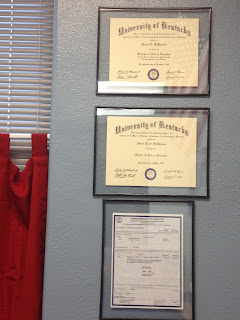
As I started unpacking boxes and cleaning off my desk, I reflected on a conversation I had this summer with a teacher from Georgia. We met while attending a conference. During one of our lunches, we discussed how teachers are often not viewed as professionals. My Georgia friend pointed out that we are one of the only professions that do not display our credentials in our workspace. He said he has always displayed his diplomas and teaching certificate in his classroom and every teacher should do the same. I sat there stunned. He was right. I didn't know one teacher who displayed his/her credentials in their classroom. Why?
I am very proud to be a teacher. As a result, I often tell my students about my journey to become a teacher. I tell them about growing up in a small town where AP classes were few. I tell them about the eighth grade counselor who told me that I shouldn't bother with the pre-college curriculum in high school because "we both know you will end up pregnant". I tell them about the amazing high school teachers who encouraged me. I tell them about how I worked two jobs to pay my college tuition. I tell them that they can be "masters of their fate", too. The diplomas and teaching certificate would be visual reminders of my hard work to my students and myself.
I have thought of the conversation with my Georgia friend often during the last few weeks. Why haven't I displayed my credentials in my room? Had I bought into the idea that teachers are not as important as other professions--doctor, lawyer, etc.? No. I feel very strongly that teaching is an important profession--even, a calling. I think I just hadn't thought about displaying these documents before. After all, no one I knew did this.
So this year, I have pulled my diplomas and teaching certificate out of storage. I bought a few frames and hung them behind my desk. It's time. Who knows? Maybe this will start a trend in my building.
I think my Georgia friend would be pleased.

Saturday, July 28, 2012
The Art of Teaching
Recently, I participated in a discussion regarding how to measure teacher effectiveness. The discussion focused on what actions, activities, or qualities could be observed by an evaluator. Ultimately, the discussion began to focus on the art and the science of teaching.
Our facilitator asked the group to specifically describe the art of teaching. Members of our group offered several ideas, but each idea centered around one thought: the bridge between the art of teaching and the science of teaching was the relationship between student and teacher.
I found myself thinking about this discussion several times over the last week. I wanted to define the art of teaching for myself and reflect on my own practice. The science of teaching is the teacher's use of tried-and-true strategies to help students learn. The art of teaching is the wisdom of knowing when and how to use those strategies.
For me, the art of teaching is acquired by experience or study. Each year, a new group of students enters my classroom and I begin to study those students. I pull out my toolkit of strategies to help my students become better readers, thinkers, and writers. Some students thrive under small group instruction. Others need one-on-one attention. Some students need graphic organizers and formulaic methods of organizing their writing. Others detest those tools. The only way I know this is by getting to know my students--observing them, talking with them, and listening to them.
The art of teaching is also reflecting on my practice. Why did I use that strategy? Why did I think it would work with these students? If it didn't work, what do I do next? It is changing up my lesson plan mid-class because I realize that it isn't working. Or having a different plan for each class. Sometimes, it is having multiple plans within one class.
To me, the art of teaching is difficult to document using most of today's teacher evaluation instruments. These instruments are checklists of 40 or more items. Rarely, does the checklist consider why a teacher makes certain choices within the context of a specific classroom. That is why the new teacher evaluation tools must include active questions rather than passive check boxes. Instead of a check box that says, "teacher uses informational texts", ask the teacher "why the teacher choose a particular informational text?". This type of question gets at the art of teaching. The teacher's response will tell you plenty about their teaching practice. A lot more than simple check boxes.
Our facilitator asked the group to specifically describe the art of teaching. Members of our group offered several ideas, but each idea centered around one thought: the bridge between the art of teaching and the science of teaching was the relationship between student and teacher.
I found myself thinking about this discussion several times over the last week. I wanted to define the art of teaching for myself and reflect on my own practice. The science of teaching is the teacher's use of tried-and-true strategies to help students learn. The art of teaching is the wisdom of knowing when and how to use those strategies.
For me, the art of teaching is acquired by experience or study. Each year, a new group of students enters my classroom and I begin to study those students. I pull out my toolkit of strategies to help my students become better readers, thinkers, and writers. Some students thrive under small group instruction. Others need one-on-one attention. Some students need graphic organizers and formulaic methods of organizing their writing. Others detest those tools. The only way I know this is by getting to know my students--observing them, talking with them, and listening to them.
The art of teaching is also reflecting on my practice. Why did I use that strategy? Why did I think it would work with these students? If it didn't work, what do I do next? It is changing up my lesson plan mid-class because I realize that it isn't working. Or having a different plan for each class. Sometimes, it is having multiple plans within one class.
To me, the art of teaching is difficult to document using most of today's teacher evaluation instruments. These instruments are checklists of 40 or more items. Rarely, does the checklist consider why a teacher makes certain choices within the context of a specific classroom. That is why the new teacher evaluation tools must include active questions rather than passive check boxes. Instead of a check box that says, "teacher uses informational texts", ask the teacher "why the teacher choose a particular informational text?". This type of question gets at the art of teaching. The teacher's response will tell you plenty about their teaching practice. A lot more than simple check boxes.
Saturday, July 21, 2012
A Teacher with a Voice
During my student teaching experience thirteen years ago, my cooperating teacher and I had several conversations about using my "teacher voice" at opportune times in the classroom. We discussed why it was important to know when to use the voice to achieve a desired effect.
Lately, the idea of teacher voice has popped up in discussions in blogs, at conferences, and around the lunch table. The conversations have focused on what exactly is the teacher voice, how can teachers best use their voices, and when is it appropriate for teachers to speak out. Everyone seems to have an opinion based upon their own personal circumstances. The purpose of this blog is to help me reflect on my teacher voice and how and when I use that voice.
Three years ago, I was worn-out and restless. I loved working with my students everyday, but something was missing. I thought of myself as an effective teacher who not only cared for my students, but was also able to prepare them adequately for the next level. Still, I wanted something more. I just couldn't put my finger on exactly what that was.
So, I began to think it was time to look for opportunities outside of the classroom. A good friend of mine even encouraged this. She said she did not want to see me burn out and leave the profession entirely. I was needed. Maybe I should take a break to rejuvenate. She was right. I needed a challenge beyond my classroom and I wanted a leadership opportunity, but I wasn't entirely sure I wanted to give up my students. At that time, I thought the only choice was to leave the classroom to be a leader. So I did.
Luckily, my school was looking for a literacy coach. The position required moving out of the day-to-day role of a classroom teacher; however, I would still be able to interact with students daily. This role afforded the opportunity to be innovative and impact policies and structures that would affect our neediest students--my heart's passion.
Through this new position, I began to find my teacher voice. That's what had been missing. I had convinced myself that I could not affect change in my school, district, and state because I was just a teacher. Sure, there were other teachers who felt like me, but what were we to do? We weren't in a leadership position where we could do anything, right? Three years ago, that is what I thought. Now, I know better. I am not "just a teacher". I am a teacher with a voice.
This fall I will be going back to full-time teaching. This time I am taking my teacher voice with me. If you like, follow my journey. Even better, begin your own. Discover your teacher voice. Use it.
Lately, the idea of teacher voice has popped up in discussions in blogs, at conferences, and around the lunch table. The conversations have focused on what exactly is the teacher voice, how can teachers best use their voices, and when is it appropriate for teachers to speak out. Everyone seems to have an opinion based upon their own personal circumstances. The purpose of this blog is to help me reflect on my teacher voice and how and when I use that voice.
Three years ago, I was worn-out and restless. I loved working with my students everyday, but something was missing. I thought of myself as an effective teacher who not only cared for my students, but was also able to prepare them adequately for the next level. Still, I wanted something more. I just couldn't put my finger on exactly what that was.
So, I began to think it was time to look for opportunities outside of the classroom. A good friend of mine even encouraged this. She said she did not want to see me burn out and leave the profession entirely. I was needed. Maybe I should take a break to rejuvenate. She was right. I needed a challenge beyond my classroom and I wanted a leadership opportunity, but I wasn't entirely sure I wanted to give up my students. At that time, I thought the only choice was to leave the classroom to be a leader. So I did.
Luckily, my school was looking for a literacy coach. The position required moving out of the day-to-day role of a classroom teacher; however, I would still be able to interact with students daily. This role afforded the opportunity to be innovative and impact policies and structures that would affect our neediest students--my heart's passion.
Through this new position, I began to find my teacher voice. That's what had been missing. I had convinced myself that I could not affect change in my school, district, and state because I was just a teacher. Sure, there were other teachers who felt like me, but what were we to do? We weren't in a leadership position where we could do anything, right? Three years ago, that is what I thought. Now, I know better. I am not "just a teacher". I am a teacher with a voice.
This fall I will be going back to full-time teaching. This time I am taking my teacher voice with me. If you like, follow my journey. Even better, begin your own. Discover your teacher voice. Use it.
Subscribe to:
Posts (Atom)